Why Filters Are the Foundation of Volvo CE Machine Reliability
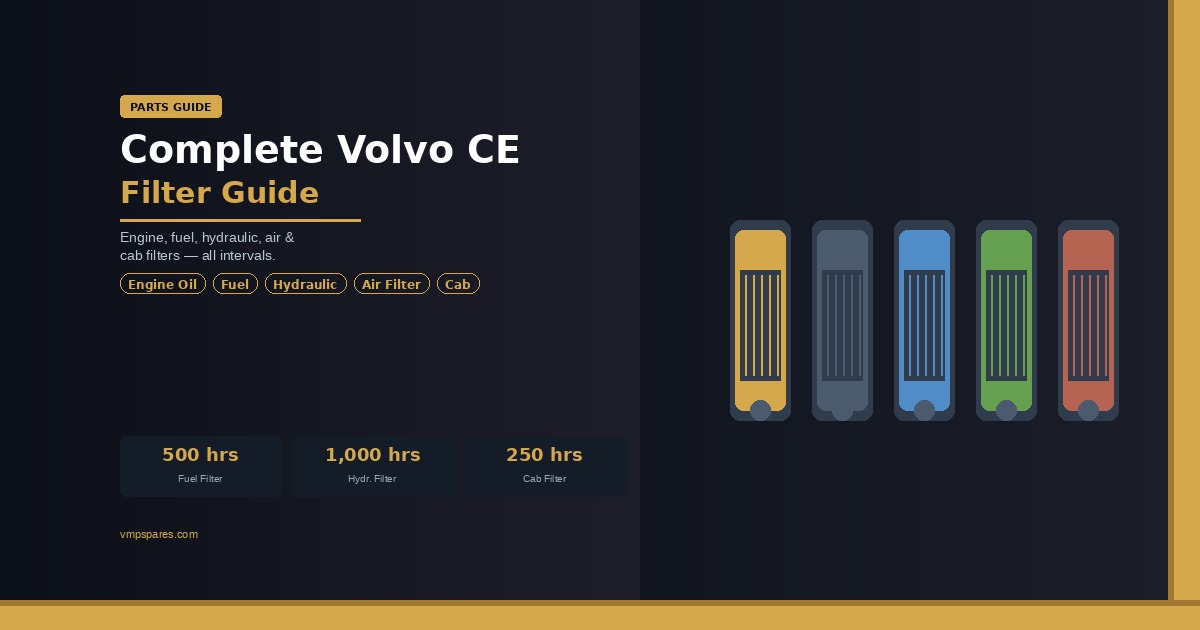
No single maintenance category has a greater impact on long-term machine reliability than filters. Every major fluid system on a Volvo CE excavator or wheel loader — engine oil, fuel, hydraulics, cooling, air intake — depends on a clean filter to prevent abrasive contamination from reaching precision components. A clogged fuel filter causes injector wear. A bypassed hydraulic filter introduces particles that score cylinder walls and valve spools. A missed engine oil filter causes bearing wear that shortens engine life by thousands of hours. This guide covers every filter type on Volvo CE machines, the correct replacement intervals and what happens when each is neglected.
Filters apply across all Volvo CE models. For model-specific parts references, see our EC480 Parts Guide, EC290B Parts Guide and EC140B Parts Guide.
Engine Oil Filter
The engine oil filter removes metallic particles, carbon deposits and combustion by-products from the lubrication circuit. Volvo CE engines typically use a full-flow spin-on filter on the main circuit and, on larger engines (D13, D16), a bypass centrifugal filter in addition. The spin-on filter should be replaced at every engine oil change — typically every 250–500 hours depending on the engine generation and operating conditions. Never run an engine with a filter that has reached its bypass pressure — the bypass valve allows unfiltered oil into the circuit, and particle contamination begins immediately.
Fuel Filter
Modern Volvo CE engines use a two-stage fuel filtration system: a primary water separator/pre-filter and a secondary main fuel filter. The water separator removes free water and large particles before the fuel pump; the main filter protects the injection pump and injectors from fine abrasive particles. Both should be replaced as a pair at the same service interval — replacing only one defeats the purpose of the two-stage system. On common-rail engines (D13J in EC480E, later D-series variants), injector tip cleanliness is critical; particles as small as 4 microns can cause injector wear that results in poor spray pattern and increased fuel consumption.
→ Browse Fuel Filters & Water Separators
Not sure which filter set fits your Volvo model and serial? We identify the correct part numbers by machine in minutes.
Hydraulic Filters
Hydraulic systems typically use three filter stages: a suction strainer (protects the pump inlet), a return filter (cleans oil returning to tank) and a high-pressure filter (on the pump outlet on some models). The return filter is the most frequently replaced — every 500–1,000 hours. The suction strainer should be inspected and replaced every 2,000 hours or whenever the hydraulic oil is changed. High-pressure filter elements, where fitted, are typically replaced every 1,000 hours. A clogged return filter that has gone to bypass is the most common cause of hydraulic system contamination events — once bypass occurs, contaminated oil circulates through the entire system, accelerating wear in pumps, motors and cylinders simultaneously.
Air Filter — Engine Intake
The engine air filter protects the turbocharger and engine internals from abrasive dust. Volvo CE air filter systems use a two-element design: an outer primary element and an inner safety element. The outer element is replaced on a service schedule (typically every 1,000 hours) or earlier if the restriction indicator triggers. The inner safety element should only be replaced when the outer element is replaced and never cleaned — it exists solely as a final barrier if the outer element fails or is incorrectly installed. Turbocharger failures caused by unfiltered air entry are extremely expensive — a D13 turbo cartridge costs €800–€2,000; the air filter costs under €50.
Cab Air Filter
The cab air filter pressurises the operator cab to prevent dust and silica ingress. On sites with fine silica dust (quarries, sandstone demolition, road milling), respirable crystalline silica (RCS) is a serious long-term health hazard for operators. A clogged or missing cab filter defeats cab pressurisation entirely. Replace every 500 hours in normal conditions and every 250 hours in high-dust environments. Never clean a cab filter with compressed air — this destroys the filter media and pushes dust back into the cab circuit.
Transmission & Final Drive Filters
Wheel loaders use a powershift transmission with its own dedicated oil and filter circuit. The transmission filter removes clutch pack debris, seal fragments and metallic particles from the shifting circuits. Transmission filter replacement every 1,000 hours is the most critical service item for preventing costly clutch pack failures. Final drives (both excavators and wheel loaders) use their own sealed oil — no filtration, but regular oil changes (every 1,000 hours) are essential to remove accumulated metallic wear particles before they become abrasive enough to accelerate gear and bearing wear.
→ Browse Transmission Filters & Drive Parts
Filter Replacement Schedule — Quick Reference
| Filter Type | Interval | Notes |
|---|---|---|
| Engine oil filter | 250–500 hrs | Replace with every oil change |
| Fuel pre-filter / water separator | 500 hrs | Replace pair together |
| Fuel main filter | 500 hrs | Replace pair together |
| Hydraulic return filter | 500–1,000 hrs | Check bypass indicator |
| Hydraulic suction strainer | 2,000 hrs / oil change | Inspect; replace if fouled |
| Air filter outer element | 1,000 hrs or on indicator | Check restriction indicator |
| Air filter inner safety element | With outer element only | Never clean; never replace alone |
| Cab air filter | 500 hrs (250 in high dust) | Never clean with compressed air |
| Transmission filter | 1,000 hrs | Critical for clutch pack life |
Ready to Find Your Part?
240,000+ Volvo CE parts | 669 machine models | 6-month warranty | Worldwide shipping
We typically respond within 2 hours with availability and pricing.