The Volvo D-Series Engine Family: Built for Heavy Construction
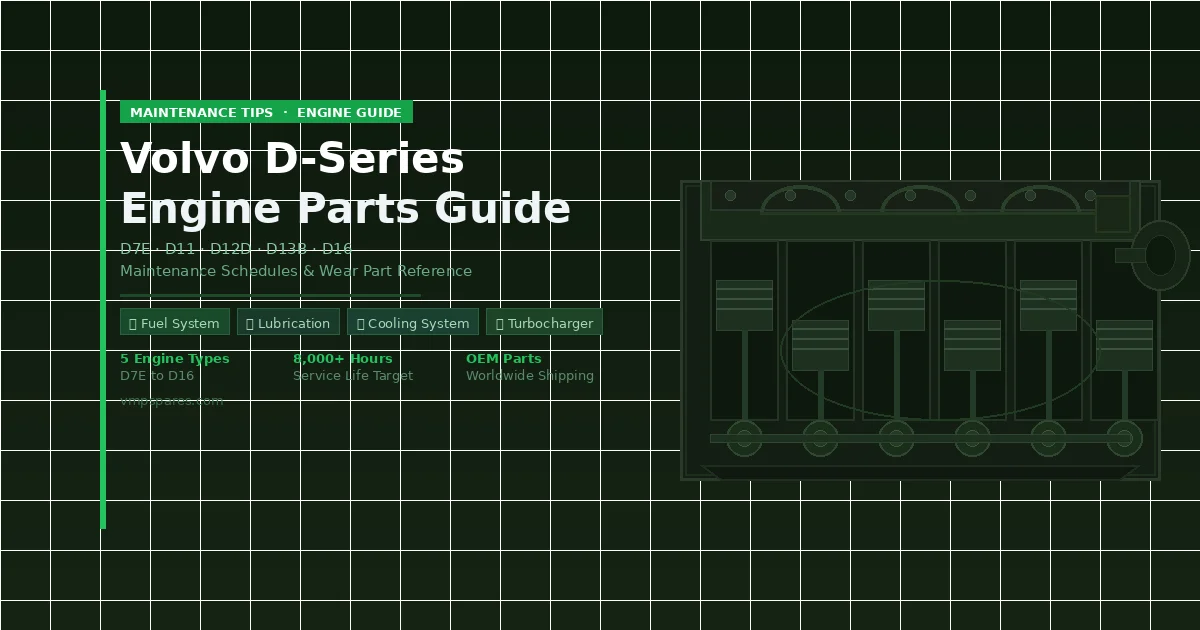
Volvo Construction Equipment has relied on its own in-house D-series diesel engines for decades. From the D7E found in mid-range excavators to the D16 powering ultra-class machines, these engines share Volvo’s core design philosophy: high torque at low RPM, low fuel consumption, and extended service intervals when maintained correctly. Understanding which D-series engine is in your machine — and what parts it needs — is the foundation of cost-effective fleet maintenance.
This guide covers the most widely serviced Volvo CE engine variants, the parts that wear fastest, and the maintenance schedule that keeps them running well past 15,000 hours.
Which D-Series Engine Is in Your Machine?
| Engine | Displacement | Power Output | Typical Models | Emission Tier |
|---|---|---|---|---|
| D7E | 7.1 L inline-6 | 155–186 kW | EC140B, EC210B, EC235C, L90G | Tier 3 / Stage IIIA |
| D11 | 10.8 L inline-6 | 216–250 kW | EC290B, EC300D, L120G, A30F | Tier 3 / Stage IIIA |
| D12D | 12.1 L inline-6 | 205–228 kW | EC360B, EC460B, L150C/E, A40F | Tier 2 / Stage II |
| D13B | 12.8 L inline-6 | 220–309 kW | EC360C, EC480D, L180H, A45G | Tier 3 / Stage IIIA |
| D16 | 16.1 L inline-6 | 397–470 kW | EC700C, EC750D, EC950F | Tier 4 / Stage IV |
Note on emissions tiers: Parts compatibility often follows emission tier boundaries, not just displacement. A D13B CE3B (Tier 3) uses different injectors and EGR components than a D13J CE4B (Tier 4) even though the block architecture is similar. Always confirm your engine’s emissions variant when ordering fuel system or exhaust components.
High-Priority Engine Wear Parts
1. Fuel System Components
Volvo D-series engines use high-pressure common rail fuel injection on newer variants and unit injector systems on older Tier 2 models. The fuel system is the most failure-prone subsystem on high-hour machines. Injector tip wear causes increased fuel consumption and visible black smoke; typical injector service life is 6,000–8,000 hours depending on fuel quality. Fuel filter condition is critical — clogged primary filters starve the high-pressure pump, causing premature wear and in severe cases total pump failure.
Key fuel system parts to maintain: primary fuel filter (every 500 hr), secondary/fine fuel filter (every 500 hr), fuel lift pump diaphragm (inspect at 3,000 hr), injector return line seals (replace at first sign of seepage), and water separator bowl (drain weekly in humid climates).
2. Lubrication System
Oil pressure maintenance is the single most important factor in D-series engine longevity. Oil pump wear causes gradual pressure loss — often noticed as extended cold-start rattle that disappears once warm. By the time the oil pressure warning activates, bearing damage is typically already occurring. Replace the oil pump at 8,000–10,000 hours proactively on high-utilisation machines. The centrifugal oil cleaner (bypass filter) fitted to most D-series engines requires emptying every 500 hours — this is frequently neglected, allowing carbon accumulation that reduces bypass oil flow.
→ Browse Lubrication System Parts
3. Cooling System
Volvo D-series engines are liquid-cooled with a pressurised closed-loop system. The thermostat is the most commonly replaced cooling part — a stuck-open thermostat causes the engine to run cold (reducing efficiency and increasing wear), while a stuck-closed thermostat causes overheating. Thermostat replacement is a low-cost preventive measure recommended every 4,000 hours. Coolant pump seal failure is the next most common issue; a weeping seal at the pump-to-block joint leaves dried coolant residue that indicates impending failure.
Keep coolant concentration between 40–60% antifreeze year-round — both for freeze protection and for the corrosion inhibitors that protect aluminium components in the cooling circuit. Replace coolant every 4,000 hours or every 3 years, whichever comes first.
Need help identifying the right engine part for your Volvo CE machine? Send us your serial number and our team will confirm fitment in minutes.
4. Air Intake & Exhaust
The turbocharger is the most expensive single engine component to replace — typically €1,200–€2,800 depending on model. Turbocharger failure is almost always caused by either oil starvation (delayed shutdown after high-load operation) or contaminated oil (extended oil change intervals). Letting the engine idle for 2–3 minutes before shutdown after heavy work allows the turbo bearings to cool before oil circulation stops — this habit alone significantly extends turbocharger life.
Air cleaner service is equally critical. A collapsed inner filter element allows fine abrasive particles to bypass filtration entirely, causing accelerated cylinder bore wear. Inspect the air restriction indicator at every fuel fill and replace the outer element every 500 hours in dusty conditions (or when the indicator shows restriction), and the inner safety element every second outer element change.
→ Browse Intake & Exhaust Parts
5. Engine Assembly & Gaskets
Head gasket failure on D-series engines typically presents as white exhaust smoke (coolant entering the combustion chamber), coolant contamination of the oil (milky appearance on dipstick), or external coolant seepage at the head-to-block joint. On the D12D and D13B, head bolt re-torquing at 1,000 hours after initial installation is specified in Volvo’s service manual and reduces the risk of gasket creep. A complete head gasket kit — including all valve cover, exhaust manifold, and coolant outlet gaskets — is the correct approach when the head is removed.
→ Browse Engine Assembly Parts | Browse All Engine Parts
Engine Maintenance Schedule — D7E / D12D / D13B
| Interval | Service Item | Part / Action |
|---|---|---|
| Daily | Engine oil level, coolant level, air filter indicator | Visual inspection, top-up as needed |
| 250 hours | Engine oil & filter change, centrifugal oil cleaner | Oil filter cartridge, drain plug gasket, clean centrifuge bowl |
| 500 hours | Primary & secondary fuel filters, air outer element | Fuel filter set, air filter outer element |
| 1,000 hours | Air inner safety element, belt inspection, coolant test | Air filter inner element, v-belt or poly-v belt set |
| 2,000 hours | Valve clearance check, injector return seals, hose inspection | Injector seal kit, valve cover gasket if needed |
| 4,000 hours | Coolant replacement, thermostat, turbocharger inspection | Coolant, thermostat & housing seal, turbocharger cartridge kit |
| 8,000 hours | Oil pump inspection, injector calibration, head bolt torque check | Oil pump kit if worn, injector set if consumption elevated |
Parts by Machine — Find Your Engine Parts Fast
VMP Spares organises engine parts by both component category and machine model. If you know your machine model and serial number, you can browse directly to your machine’s parts catalogue and filter for engine components.
| Machine | Engine | Parts Link |
|---|---|---|
| EC140B | D7D / D7E | Browse EC140B Parts |
| EC210B | D7E CE2B | Browse EC210B Parts |
| EC360B | D12D CE2B | Browse EC360B Parts |
| EC360C | D13B CE3B | Browse EC360C Parts |
| EC480D | D13B CE3B | Browse EC480D Parts |
| All Excavators | All D-Series | Browse All Excavator Parts |
Common Engine Failure Patterns — What to Watch For
High-hour Volvo D-series engines follow predictable failure patterns. White smoke on cold start that clears after warm-up is normal condensation; persistent white smoke at operating temperature indicates coolant ingestion — check head gasket and cylinder liners. Blue smoke indicates oil combustion — check turbocharger seals, valve stem seals, and piston rings. Black smoke indicates rich fuelling — check injectors, air filter restriction, and turbocharger boost pressure.
Unusual coolant consumption (more than 0.5 L per 8 hours) without visible external leaks is an early warning of internal head gasket failure. Oil dilution (coolant mixing with oil, creating a milky emulsion visible on the dipstick) is a more advanced stage requiring immediate engine shutdown to prevent bearing damage.
Catching these patterns early — through regular fluid sampling and visual inspection — is the difference between a €200 seal kit repair and a €15,000 engine overhaul.
Ready to Order Your Engine Parts?
240,000+ Volvo CE parts | 669 machine models | 6-month warranty | Worldwide shipping
We typically respond within 2 hours with availability and pricing.