Volvo CE Undercarriage Maintenance: Maximising Track System Life
Proper undercarriage maintenance is the single highest-ROI maintenance activity on a tracked Volvo CE excavator. Studies consistently show that undercarriage life can vary by 100–200% on identical machines in identical conditions — with the difference being operator habits, tension management, and terrain selection. The undercarriage is not a wear-and-replace-when-broken system: it requires active management to hit its designed lifespan. → Undercarriage parts guide and parts in stock at VMP Spares.
Track Tension: The #1 Undercarriage Life Factor
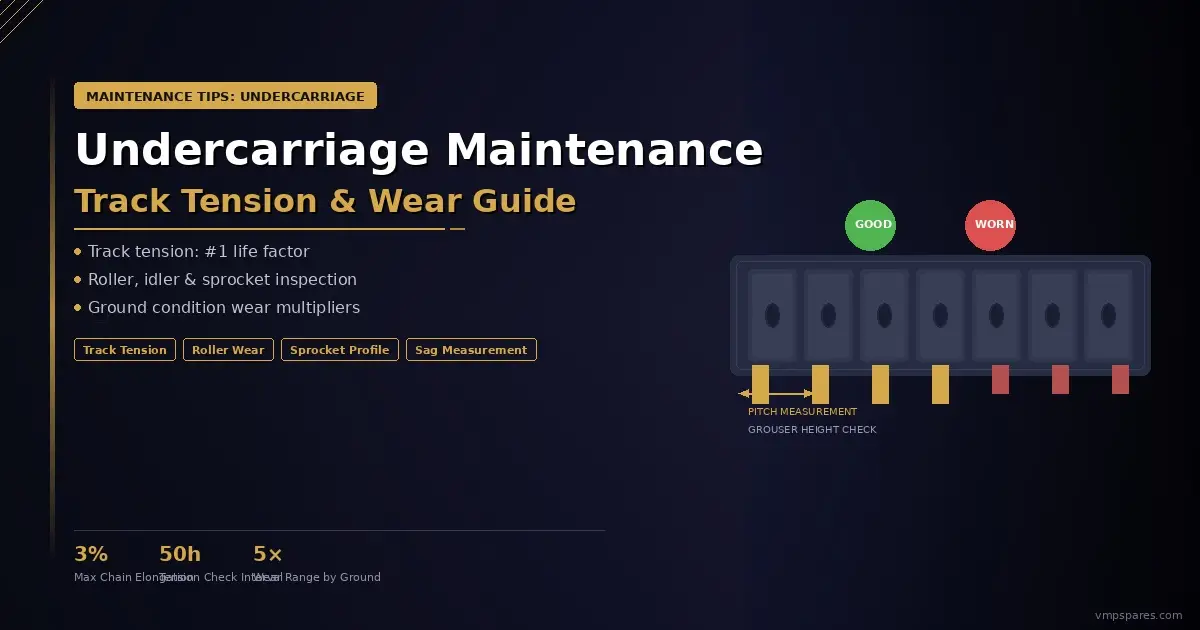
Incorrect track tension is responsible for more premature undercarriage wear than any other single factor. The effect is asymmetric: running too loose causes 3× more wear than running slightly tight. The correct sag measurement must be checked every 50 hours and after every ground condition change:
| Track Condition | Effect on Components | Consequence |
|---|---|---|
| Correct tension | Normal wear distribution | Full design life achieved |
| Too loose (excess sag) | Chain jumps on sprocket; shoe flap; roller flange wear | 2–3× accelerated wear; derailment risk |
| Too tight (insufficient sag) | Increased load on pins/bushings/rollers | Seal failures; bushing seizure; bearing wear |
| Irregular tension | Uneven wear side-to-side | Premature one-side replacement needed |
How to Measure and Adjust Track Tension
The track sag measurement is taken at the mid-point of the upper run, between the front idler and the first top roller. Place a straight edge across the top rollers and measure the maximum downward sag of the track chain. Compare to your model’s specification (typically 25–45mm depending on machine class):
| Step | Action |
|---|---|
| 1 | Drive machine forward 3 machine-lengths on flat, firm ground |
| 2 | Stop without braking or reversing — this loads the track correctly |
| 3 | Place straight edge across top rollers (upper run) |
| 4 | Measure sag at midpoint with ruler or tape measure |
| 5 | If too loose: add grease via recoil cylinder zerk fitting |
| 6 | If too tight: open relief valve slowly to release grease — NEVER remove plug completely |
| 7 | Re-measure after adjustment; repeat until within specification |
Track adjustment or undercarriage parts needed? Our team can help identify the correct tension spec for your Volvo CE model and confirm parts availability.
Roller & Idler Inspection Schedule
Bottom rollers, top rollers, and idlers are sealed for life — but their seals do wear. The earliest sign of seal failure is a trail of oil left by the machine during operation. Never ignore roller oil leaks: a run-dry roller bearing collapses quickly and can damage the track chain and frame. Inspection schedule:
| Check | Interval | Pass / Fail Criteria |
|---|---|---|
| Oil trail inspection | Daily / every 10h | No oil trail on ground — any trail requires investigation |
| Roller flange wear | Every 250h | Measure flange height — replace when <5mm remaining |
| Side-to-side roller play | Every 500h | Maximum 3mm lateral play |
| Idler rim wear | Every 250h | Rim width should be within ±3mm of specification |
| Idler guide lip | Every 500h | Lip guides track — replace when worn flush |
| Top roller bearing play | Every 500h | No visible wobble during operation |
Sprocket Wear Monitoring
Sprocket tooth profile changes predictably as it wears. A new sprocket has smooth, rounded tooth faces. A worn sprocket develops a hooked, sharp profile — this “shark tooth” shape accelerates chain elongation significantly. Check profile visually every 500 hours:
| Sprocket Condition | Visual Appearance | Action |
|---|---|---|
| New / good | Smooth rounded tooth sides, full root radius | Continue normal monitoring |
| 50% worn | Some flat spots on tooth faces, root still full | Monitor closely; plan replacement |
| 70% worn | Definite hook developing on tooth leading faces | Replace at next service opportunity |
| Worn out | Sharp hook/spike profile, cracked roots visible | Replace immediately — damaging chain |
Ground Condition Impact on Undercarriage Life
Ground conditions affect undercarriage life more than any other operational factor. Operators who understand this can adapt machine usage to extend track life significantly. As a guideline, abrasive sandy rock can reduce undercarriage life to 30% of that achieved in soft clay:
| Ground Type | Wear Rate Multiplier | Optimization Strategy |
|---|---|---|
| Soft clay / loam | 1.0× (baseline) | Standard tension; all shoe widths suitable |
| Mixed gravel / compacted soil | 1.5–2.0× | Use wider shoes; tension at low end of spec |
| River sand / granular | 2.0–3.0× | Wide shoes; frequent tension checks; clean tracks daily |
| Crushed rock / quarry | 2.5–4.0× | Rock-guard shoes; tighten tension; expect higher cost |
| Demolition / concrete rubble | 3.0–5.0× | Reinforced shoes; daily inspection; plan short life |
Undercarriage Wear Measurement System
Volvo recommends using the undercarriage wear measurement tool (Service code STP99-001) at each 1,000-hour service. Key measurements to record and trend:
| Measurement | Wear Limit | How to Measure |
|---|---|---|
| Track chain elongation | Max 3% of pitch (e.g., ≤195mm for 190mm pitch) | Measure 10-link length; calculate elongation |
| Shoe grouser height | Min 15mm remaining | Measure from shoe plate to grouser tip |
| Roller flange OD | Replace at 80% of new OD | Outside caliper measurement |
| Idler rim width | Replace at 80% of new width | Caliper across rim contact surface |
| Sprocket root radius | Replace when hook forms | Visual assessment + profile template |
→ Related: Undercarriage parts selection guide | Extending excavator life to 15,000 hours | Pre-season inspection checklist
Ready to Find Your Part?
240,000+ Volvo CE parts | 669 machine models | 6-month warranty | Worldwide shipping
We typically respond within 2 hours with availability and pricing.